

I’ve been talking about this a lot lately. I don’t just want to talk about money. But this has ended up being a huge part of my conversation lately, so let’s just continue the thread. Here’s some more thoughts for this week. Two posts in a week.
Have you subscribed to the podcast? We’re talking about a lot more than money, and if you like what I write, maybe you’ll like what Nick and I talk about. Episode 5 on truth just dropped yesterday.
On to today’s thoughts //
10 For the love of money is a root of all kinds of evils. It is through this craving that some have wandered away from the faith and pierced themselves with many pangs.” (1 Timothy 6:10)
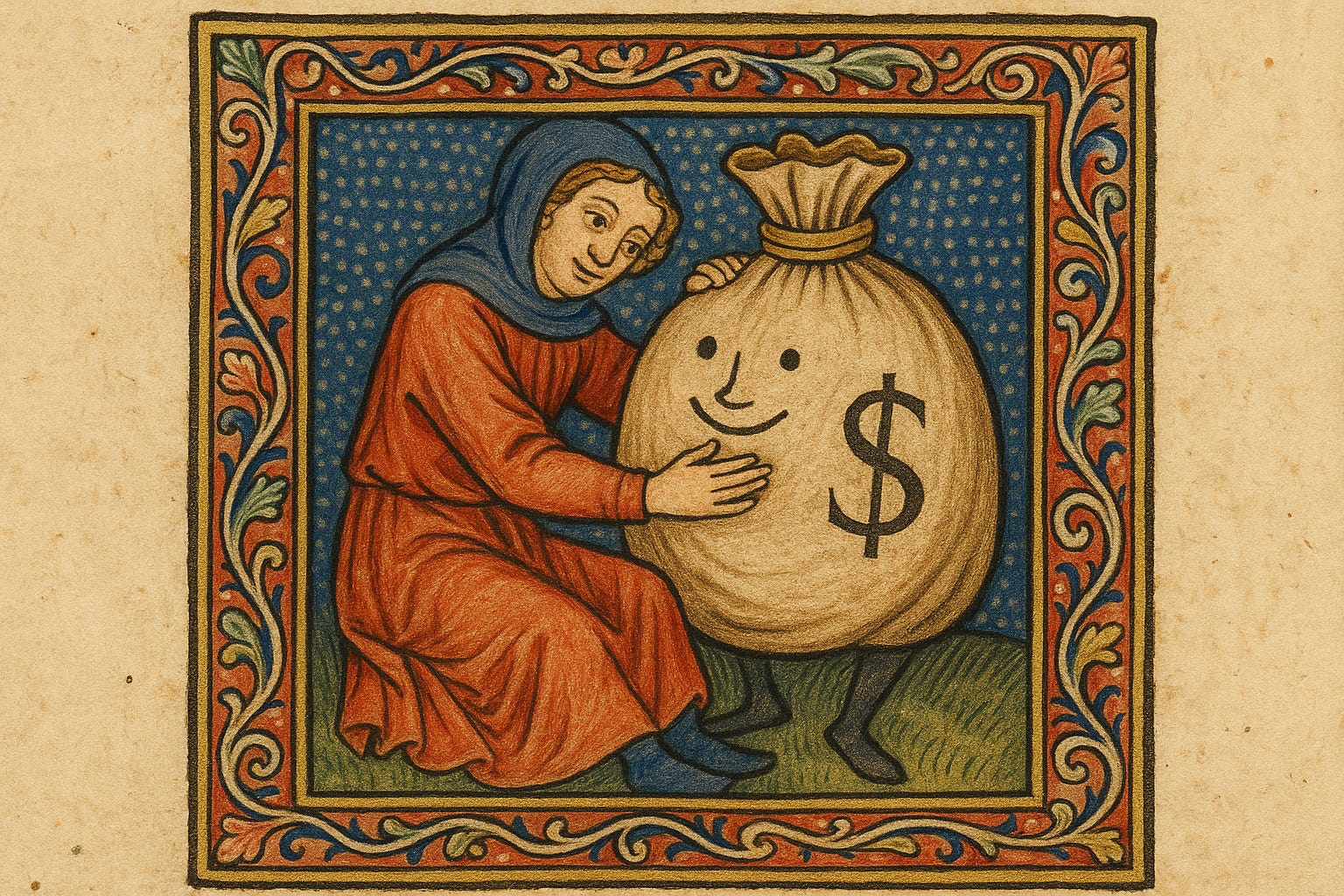
I really like the Greek word for love of money. It is φιλαργυρία (philarguría). A friend of silver. Some of my favorite philosophers growing up - Chamillionaire and Paul Wall - said it best, “my money gets jealous.” You might not think that you love money. But how tight do you hold onto it? How much do you think about it? How much of your focus does money get compared to the other types of wealth you have? For most of us, we spent an inordinate amount of time thinking about money. I believe that’s because we love it so much, but we have a hard time seeing it, or admitting it.
When I was 16, my life savings was $1000. I remember how great it felt logging into my bank account and seeing three zeroes that I had earned and saved for the first time. I loved it. I loved my money, and I loved seeing it in the bank. So, I gave it all away in an offering. Fast forward to age 21. I’m graduating from college, I have saved up $10,000 through my time in school. I loved that too. So the weekend I came home from college, I gave it all in the offering. When I started working, I started giving a third of my income at church. When I got married, my dad - who is also my pastor - knew how much I was giving and told me that I shouldn’t give that much, and it was unwise. I mostly kept doing it anyway. A few years ago, I gave $100,000 over the course of a year for the first time in my life. Every year since, I continue to get closer and closer to giving $200,000 in a year. Why am I telling you this? To brag about how much money I don’t keep? No. I’ve discovered a secret along the way. Giving $100,000+ hurts just as much at 38 as giving $1000 hurt at 16, and as much as giving $10,000 hurt at 21. Every time I am generous, I am both feeling and fighting the love of money within me. Silver and I would be best friends if I let that happen.
Unless we can admit the problem, we have no hope to cure it. The desire for financial wealth is more often than not, a trap. We often don’t realize that we are in that trap. Sometimes I have gone into my savings account to give. I have foregone vacations, or nice things in my life so that I can give. Do I recommend that? No. But it helps prevent me from becoming too close with my money.
Here’s another secret. Most of the people that have the biggest problem with talking about money in a spiritual context are in love with money. They don’t like what I’m writing about because I’m talking about money. And their definition of prosperity is money. They don’t like going to church because the church is going to talk about money at the offering time. Go read a Google review of your local church. The odds are there will be plenty of people saying “all they talk about is money.” Especially if that church is seen as a megachurch. Have you ever decided to buy a car, and you have set your mind on a specific model. In the next few days, you see that car wherever you go? It feels like suddenly, everyone is driving a car. In psychology, this is called the Baader-Meinhof Phenomenon, or the frequency illusion. It is the false impression that something is happening more frequently than it actually is. It’s not that the thing has become more common, it’s just that your brain is paying more attention to it. This phenomenon takes place because of two psychological effects:
Selective attention - Whatever you think about, your mind will unconsciously look for when you are not thinking about it.
Confirmation bias - Everytime you see what you think about, it reinforces the feeling that it is “everywhere.”
What does this have to do with money and churches? If I have already convinced myself that a church “just wants my money.” I will find all the reasons why that hypothesis is correct everytime I go to a church. Just like If I get a green car, I will see green cars a lot more.
People who are friends of silver always have a hard time when you ask them to not be friends with silver. The problem is not how often the church talks about money. The problem is how often we think about money. And because we think about money so often, all we hear is “the church” talking about money. One thing you’ll see in many people that think like this is that they are rarely generous, if at all. And if they are generous, their generosity has strings attached that allow them to control things with money. So, even when they give money away, they are still friends with it, because they are controlling its use. Remember earlier when we talked about substituting man-made ideas for God’s commands? About ten years ago, I spoke a message on tithing in our church. I feel bad for every 20-something that has to get on stage in a main church service and share. Why? Because many of the “adult” armchair theologians come out of the woodwork to correct your theology almost as soon as the words come out of your mouth. If you’re a person who goes to church and feels the need to address or correct the speaker on what they said, how they said it, or otherwise debate with them about your perspective on what they should have done, let me help you. If they didn’t ask you for your opinion before they preached the message, they definitely aren’t asking for it after they preached it. The motto of the church isn’t “have it your way.” That’s Burger King. If you don’t like the music, change the station. I digress…
So I preached a message on tithing. And a man I had never met, who was significantly older than me approached me in the lobby. He let me know that I was wrong about my stance on tithing and I must not have studied very well for my message. If I was going to preach from the platform in a church service, I should really make sure I know what I’m talking about. This guy must be a lot of fun at parties. I said: “can I ask you a question?” He smiled and said “sure.” I said: “tithing is the Old Testament standard, and you say that’s no longer required, so that must mean that you live by the New Testament standard then?” He looked at me blankly for a second and then said something like: “I’m not sure what you mean?” I said: “Well, in Acts chapter 2 and Acts chapter 4 the Bible says that the people in the church sold their possessions and gave everything to the church so that no one in the church had needs. You must practice that style of generosity.” He said: “I’m going to have to study that a little further,” and walked off. I would be lying if I said I didn’t feel a little smug after that conversation. I don’t tell that story as a “gotcha” to show how much I know. I tell that story because it represents the majority of interactions that I have had with you-don’t-need-to-give Christians. Past, present and future, I will say things from a stage that are worthy of correction. This just wasn’t one of those times.
What’s the goal of any generosity from God’s perspective? To get us to not be friends with money. Some people have taken this to mean we should hate prosperity. That’s what we’ll talk about in this section. First, we need to understand the core problem we have. This core problem is the desire within us to love money. To focus on all the things we want, not the things we actually need. So ask yourself how good of a friend you are to your silver? How tempted are you to love money?
Wow. This is honestly one of the most thoughtful and clear explanations on biblical prosperity I’ve ever come across. This changed my perspective on prosperity entirely. Thank you for writing this