

I’ve mentioned (more than a few times) that according to recent studies, only 4% of Christians have a Biblical worldview. I recently learned that I was not communicating that correctly. The good news is, I recently discovered that’s not true. Only 4% of Americans have a Biblical worldview. The bad news is, Christians aren’t doing that much better. Only 6% of Christians have a Biblical worldview. Unfortunately, only 12% of people who consider themselves “theologically defined born-again Christians” have a Biblical worldview. (Source)
What’s a “theologically defined born-again Christian?” A person who:
Have a personal belief in Salvation
They believe they will go to heaven after they die because they have confessed their sins and accepted Jesus as their personal savior.
Have a high view of Scripture
They generally accept biblical teachings on sin, grace and salvation as authoritative guides for their lives.
There are a lot of implications here. But for today, let’s say that 88-96% of us most likely interpret faith through the lens of traditions and interpretations that have been handed down to us. Not truth itself, but interpretations of truth. There’s a story I’ve heard my dad tell my whole life. There was a man whose wife would always cut the ends of the ham whenever she made ham. Now, I don’t really eat ham, but I do eat brisket. Burnt ends are some of the best tasting brisket you can eat. So, I imagine the ends of the ham are like the burnt ends of a brisket. I can imagine how it would feel to have your spouse get rid of the most delicious parts of the meal. This man asked his wife one day why she cut the ends off the ham. She said, “because my mother did.” He went to her mother, she had the same answer, “because my mother did.” He went to her grandmother, same answer. Finally, he gets to the great grandmother. She says to him, “because I never had a pan big enough for the ham to fit into.”
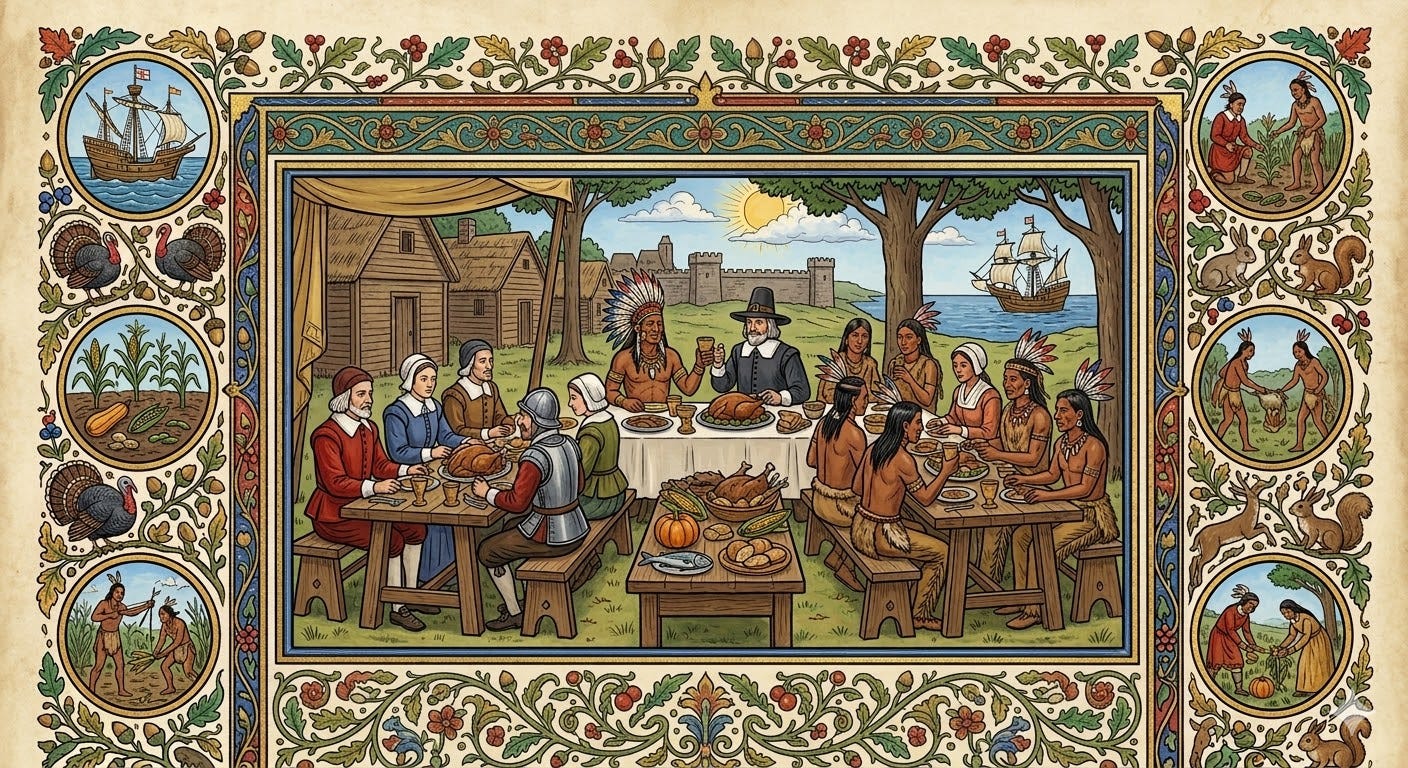
Not all of our traditions work this way. However, most do. They are convenient things that happened in a certain specific situation, that then became rules we have to follow. Why do we eat Thanksgiving foods on Thanksgiving? It’s definitely not because they taste good. We eat Thanksgiving food on Thanksgiving because when Abraham Lincoln made Thanksgiving a national holiday in 1863, it was the closest thing they had to what the Pilgrims and Wampanoag tribe ate at the harvest feast in Plymouth in 1621. I would hope, just like other progress we’ve made over the past 400 years, we could progress in our approach to Thanksgiving foods. If we can discover electricity, invent the internal combustion engine, the printing press, airplanes and the internet, we should - in my opinion - progress in our culinary tastes as well. Because Thanksgiving food is the worst type of food.
You may read these words and say: “that makes sense.” But the truth is, we are all Pharisees - slaves to tradition - in some way. People go to churches every weekend across America, observe the pastor of the church and say things like: “the pastor should know everyone in the church by name.” “The pastor shouldn’t preach on that subject.” “The church should only sing hymns.” “The only proper way to pray is to pray ‘in Jesus’ name.” “A church shouldn’t use instruments or sound systems.” “ A church shouldn’t be more than 100 people.” “A church should meet in a house, not a big building.” “A church should only sing Psalms, because those are the only ‘worship songs’ in the BIble.” “Christians should observe all of the Jewish feasts because that’s what the Jews did in the Old Testament.” All of these things are real things I can remember people saying. There are so many more traditions, these are just some of the ideas I can name off the top of my head.
I grew up in the Charismatic side of Christianity. In my opinion, Charismatics are one step below “snake handlers” in the Christian-weirdness-hierarchy. One of the things I heard in children’s church growing up was that the reason we prayed in tongues was for two primary reasons.
First, when you pray in tongues, you’re closer to God than everybody else, you have the secret knowledge and ability that no one else has.
Second, when you pray in tongues, the devil can’t “steal” your prayers. What does that mean? Well, in my mind, I thought prayer worked like a pneumatic tube at the bank. There were two tubes. One was regular prayer, the other was when you prayed in your “heavenly language.” If you prayed a regular prayer, your prayer might not get to God. If you prayed in tongues, it was like an indestructible prayer tube that the devil couldn’t prevent from getting to God. As if my prayers when I spoke in tongues were given priority access directly to the VIP throne room in heaven and sealed in a golden envelope.
Both of these ideas are Charismatic traditions that many people heard growing up that are also nowhere in Scripture. Charismatic theology does some gymnastics to assert these points, but there is no concrete Biblical backing to this tradition.
Some of you got nervous I was talking about glossolalia. Some of you got excited. Some of you are still mad that I insulted your favorite food - Thanksgiving food. Well, that’s actually impossible, because no one likes that. Traditions work a lot like flavors. There’s nothing inherently wrong with having a flavor that you like. There is something wrong with saying “everything has to be my flavor, because my flavor is also God’s flavor.” The danger of traditions is that traditions often become more desirable than what’s written in Scripture. To become a Pharisee, all we need to do is want our flavor more than we want the truth written in God’s word.