
4.1 / $ + ancient western history (10,000 BC - 500AD)
tracing the history of thinking about money and prosperity.

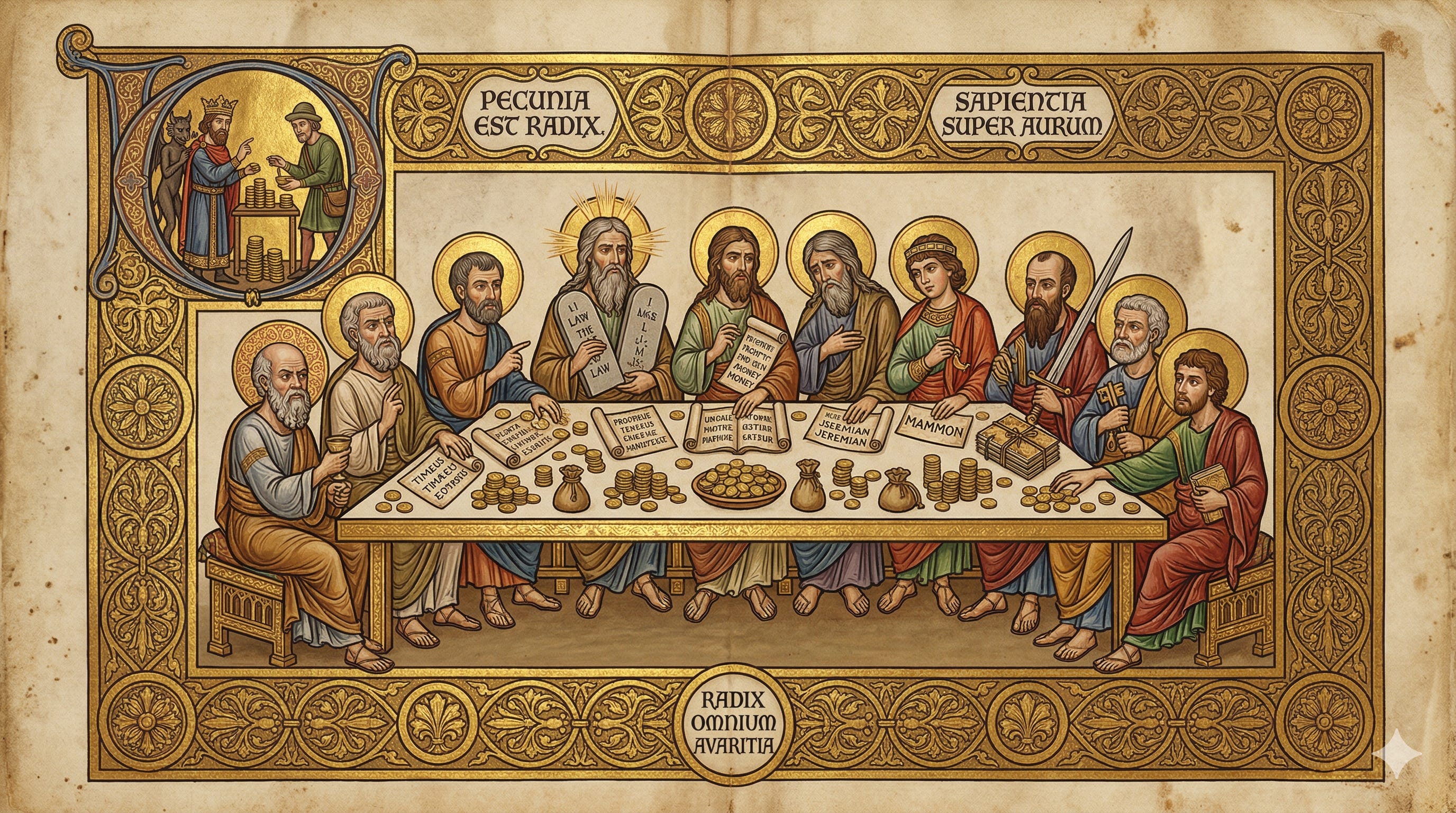
Traditions on prosperity attempt to answer this question: “how can I embrace prosperity and deny the love of money?” Now that we understand the nature and origin of traditions, let’s look at how they have progressed throughout our history. Although we have defined prosperity in a bigger context than money. Most ancient thinking - like ours - about prosperity is centered around the accumulation of physical wealth.
Let’s start with the Old and New Testaments. In the Old Testament, prosperity was seen as a sign of divine favor for following God’s commandments. From the beginning of Abraham’s journey, the Israelites sought prosperity - a promised land from God. God promised to bless them if they followed His commandments. There is no doubt that God enabled people all throughout the story of the Old Testament to achieve prosperity in all its forms and that it was a sign of God’s hand on their life. In the New Testament, prosperity is something meant to help others through generosity. The New Testament doesn’t deny prosperity. If the Old Testament tells us that prosperity comes from God, the New Testament tells us the purpose of prosperity. Every person who receives the “good news” and comes out of a poverty mindset has a responsibility. The responsibility attached to the prosperity God gives us is to help other people prosper. There are parts of the New Testament that are critical of prosperity. All New Testament criticisms on prosperity have the same core issue: prosperity without the purpose of generosity. The problem in the New Testament world was not rich people. It was rich people who did not see the purpose of their wealth attached to the responsibility of generosity.
non-biblical perspectives
What were the ancient non-biblical perspectives on wealth? What are the views of western and eastern philosophers who were living in and around the same time period? The Bible, eastern and western philosophy all converge to a singular point: wealth is a useful servant and a terrible master. Wealth is a double-sided coin. It can support a virtuous life, and create a more ethical world for everyone to live in. Or, it can corrupt us, and greed creates a worse world for everyone. The goal of living is to seek virtue and wisdom, prosperity is a tool, not an outcome.
In Plato’s Apology, Socrates declares that “virtue does not come from money, but from virtue comes money and all other good things to man” (Source). His perspective was that financial wealth was not essential for a good life, but the pursuit of virtue is. Chasing money without virtue corrupts the soul, but chasing virtue instead of money brings all good things into our lives.
In The Republic, Plato portrays both excessive wealth and poverty as threats to social harmony and virtue. His solution is to eliminate the majority of private property. He believed that “None must possess any private property save the indispensable,” and the leaders of society are told they already have “gold and silver of divine quality in their souls, so they have no need of the metal of men…since many impious deeds have been done because of [mortal] gold” (Source). Plato argues that physical wealth is not inherently evil, but must be held in check by justice and virtue. Wealth is a potential vice unless it is held in check by wisdom. Prosperity is only acceptable when it does not compromise ethical conduct, or the well-being of others.
Aristotle saw wealth as a means to an end. In the Nicomachean Ethics, he says: “The life of money-making is one undertaken under compulsion, and wealth is evidently not the good we are seeking; for it is merely useful and for the sake of something else” (Source). Like his teacher Plato, and Plato’s teacher Socrates, Aristotle sees the pursuit of wealth for the sake of wealth as not good. Wealth was a tool that could enable virtue or vice depending on the ethics of the wealthy person. Wealth could support a good life, but a love of riches for their own sake was a “narrowness of soul” and did not lead to a good life.
Thank you for share your research. You have a thought provoking prospective