

If you’ve recently joined me, welcome! For a while now, I’ve been in the process of comprehensively studying prosperity throughout scripture and history. This is a part of (what is becoming) a long series on the prosperity gospel. If you’re just starting, there are many sections on dokeo about all kinds of topics. I encourage you to go back to the beginning of this series on prosperity and get some context.
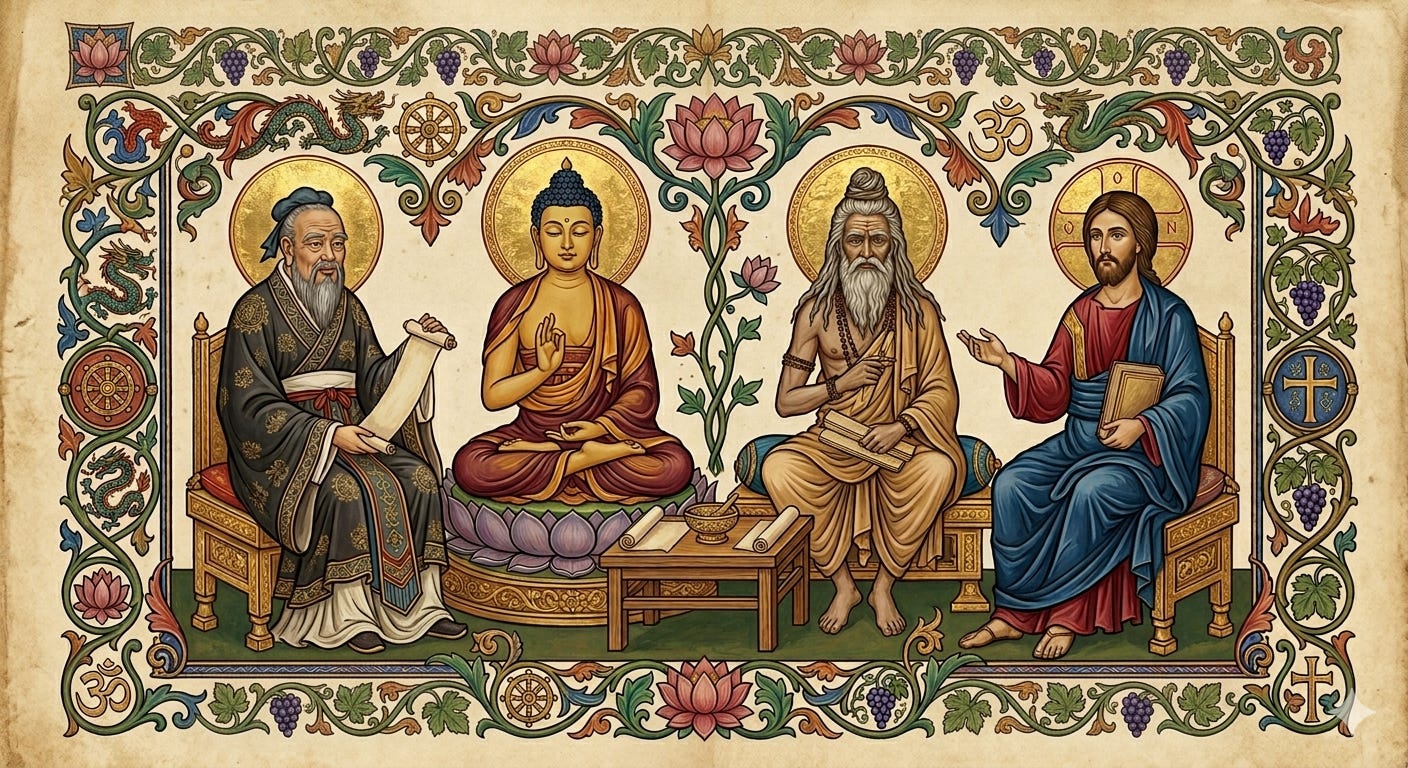
In the world of eastern philosophy, Confucius taught that comfort and prosperity have their place, but they should never be placed above our moral duty to others. Confucius acknowledged that “riches and honors are what men desire,” but he immediately cautioned: “If they cannot be obtained in the proper way, they should not be held.” (Source) In Confucian thought, it was not inherently wrong to have money or a high position, provided these things were attained with integrity and used to ease other people’s economic burdens, practice charity, and live modestly. The ideal Confucian leader “keeps propriety (the right way to act in every situation) even in wealth” and “shares it with the people.” Confucianism views wealth as morally neutral but dangerous: it is acceptable and even beneficial if gained and used in accordance with virtue, justice, and helping others, but it becomes a vice when pursued at the expense of righteousness or when it leads to arrogance and moral complacency.
In Hinduism, the framework for a good life is called पुरुषार्थ (Puruṣārtha), meaning “the purpose of a human being” or “the object of human pursuit” (Source) In Hinduism, there are four goals that are necessary for a fulfilling and happy life:
धर्म (Dharma) - Living according to virtue
अर्थ (Artha) - Material wealth and security
काम (Kama) - Pleasure and beauty
मोक्ष (Moksha) - Freedom from ignorance
Material prosperity is recognized as a legitimate goal in life, but is a part of pursuing a larger picture of living a good life. The Encyclopedia Britannica summarizes it by saying “As the immoderate pursuit of material advantage would lead to ruinous excesses, artha must always be regulated by the superior aim of dharma (righteousness).” (Source). Wealth is seen as a positive when it is the fruit of the pursuit of virtue, and enables generosity. Gandhi summarized it this way: “Earth provides enough to satisfy every man’s needs, not every man’s greed.” (Source)
Siddhartha Gautama - The Buddha - was born a prince and was surrounded by luxury for much of his early life. He famously renounced his wealth in the pursuit of enlightenment. In Buddhism, craving and clinging to material things is an impediment to spiritual liberation. The Four Noble truths (चत्वारि आर्यसत्यानि) are the key tenets of Buddhism. They are considered by Buddhists to be the proper view of reality. They are:
दुःख (Duhka) - Life is suffering
समुदय (Samudaya) - Suffering is caused by craving external things we cannot control
निरोध (Nirodha) - Suffering can be ended when we stop craving external things
मार्ग (Marga) - To stop these improper cravings, we must practice the “Noble Eightfold Path”: “Right view, right resolve, right speech, right action, right livelihood, right effort, right mindfulness, right concentration.” (Source)
The central thought of Buddhism is that life is suffering, and our suffering is caused by improper desires. It’s worth mentioning here that the Buddhist idea of suffering is not how we define suffering in the West. Suffering is more of a synonym for dissatisfaction. If we are dissatisfied for long enough, or in a significant enough way, this can certainly lead to suffering. So, life is dissatisfaction. Dissatisfaction is caused by craving external things. Dissatisfaction is ended when we stop craving these things.
Greed for money and possessions is an example of this type of craving. Buddhist teachings caution that the pursuit of wealth for its own sake increases dissatisfaction. Inner contentment is to be valued above everything else. A person who is content and free from greed is considered truly rich in spirit. Buddha himself said that “Health is the greatest gift, contentment is the greatest wealth, a trusted friend is the best relative, Nirvana is the highest bliss.” (Source) There is also a series of teachings called the Sigalovada Sutta in which a merchant sought the Buddha’s advice on how to live life virtuously. In these teachings, Buddha discusses obtaining and managing wealth. He says that “the wise man gathers wealth as a bee collects honey.” A bee is able to collect pollen and cultivate honey without destroying flowers, or other bees. And the bee slowly collects it bit by bit. Once wealth is collected, Buddha gives four steps to balancing money:
Enjoy it and consume it to balance your needs.
Invest it and use it for your education and growth.
Save and deposit it for the future.
Support friends, family, the community and religious causes.
Wealth is not meant to be used in ego-driven, or unhealthy ways, and comes with moral responsibility. Attachment to wealth, stinginess and greed are spiritual poisons that bind a person to a life full of suffering.
tl;dr
The Bible, eastern and western philosophy all converge to a singular point: wealth is a useful servant and a terrible master. Wealth is a double-sided coin. It can support a virtuous life, and create a more ethical world for everyone to live in. Or, it can corrupt us, and greed creates a worse world for everyone. The goal of living is to seek virtue and wisdom, prosperity is a tool, not an outcome.