

“The test of a first-rate intelligence is the ability to hold two opposing ideas in mind at the same time, and still retain the ability to function.” / F. Scott Fitzgerald
Reality contains tensions that can’t always be simply resolved or even understood. The same is true in the quantum world. The way to “understand” quantum physics is not through observation, but through the language of math. However, the math behind quantum physics is incredibly complicated and hard to understand. And often says things that are counterintuitive. For instance, in our daily lives, solid objects can’t pass through each other. They are solid after all. However, in quantum physics, they can. Imagine learning your whole life that up is up and down is down, but then observing that what you think is up is actually left, and what you think is down is actually up. How does this work? There are three dimensions that make up objects. Length, width and height. All three of these dimensions go certain directions. A one-dimensional object is a line. It can only go one direction, forward or backward. That motion makes a line. If we add a dimension to a line, we get a square. The shape can now move forward and backward and left and right. That motion makes a square. If we add another dimension, we create a three-dimensional object called a cube. That shape can move forward, backward, left, right, up and down. Those are the three dimensions that we understand.
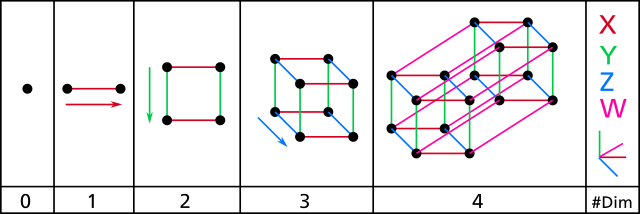
What if we added another dimension? Is that possible? The math says that it is. This forms a shape called a tesseract. It moves in an additional direction within a fourth dimension. We can’t describe this direction, or say what the direction is, but the math says it’s there. This dimension is inaccessible to our senses but has been rigorously described by math. A tesseract is to a cube what a cube is to a square. It has a name, a mathematical definition, size, and measurements, but we also can’t understand or imagine the shape of one. It doesn’t exist in the physical world as we know it, but it does exist in mathematics. We can’t see this fourth dimension, but we can describe it. If that wasn’t enough to bend our minds, we can’t visualize a tesseract. We can represent it through a 3d projection. But that visualization is limited. If you held up a cube to a light source it would cast a 2d shadow. A 3d rendering of a tesseract is a shadow of the 4d object. Quantum physics shows us that there is much more than what we know. In fact, there is more than we can understand.
What do quantum physics and tesseracts have to do with the meaning of life? To be great philosophers requires us to embrace a lack of direct experience. It also requires us to embrace a great experiment called life. Our knowledge and experience will always be limited by our humanity. Math can describe an object that exists that we can’t perceive. Truth also describes for us a reality that exists that we often can’t perceive. It is hard for us to perceive a world where free will and determinism are both true. Where God has a plan and we also have responsibility. These are two seemingly opposing ideas that we are being asked to hold in our minds at the same time. The idea of both things existing at the same time can feel the same to our brains as the existence of a tesseract. But the truth and the math both agree that it’s possible. Similarly, think about this duality: truth is objective and application of truth is subjective.
Truth – like the laws of physics – isn’t something we created. It exists independently of us. We can know the truth, but we can’t change it, only interpret it. Our interpretations of truth are subjective. Our interpretations of truth are our theories about life. The theories we have about life determine the decisions that we make. The decisions that we make have consequences, also known as fruit. Fruit is what happens when our subjective interpretations of truth (theories) collide with reality (truth). This is experimentation. In physics, theory and experimentation meet to produce results. In life, our theories and experimentation meet to produce consequences.
Theory is tested by reality and belief is tested by fruit. Like a tesseract we can only perceive through math, the meaning of our life is first held in our beliefs. No one can see or percieve it, but we can. The way we reveal the meaning of our life is through experimentation. We must embrace the uncertainty of experimentation with truth to see if we can produce the right kind of outcomes in our life. This will always feel uncomfortable. Like trying to imagine the shape of a tesseract or the movement of the fourth dimension. Yet it is necessary for us to discover whether our beliefs align with truth. Truth is perfect, our application is not. When we are willing to embrace experimentation, we are also willing to allow fruit to correct our beliefs. When we see fruit in our own life, our confidence is strengthened that we are headed in the right direction. When we see the fruit of another person’s life or philosophy we might disagree with, we are forced to reconsider our own philosophy. When we see a lack of fruit in our life, we must be willing to abandon theories that don’t align with truth. Living a meaningful life isn’t about getting everything right the first time. It is more about making sure that when we don’t get it right, we pay close enough attention to change our theories and try again.
Deep thoughts about the correlation of quantum physics and fruit in our lives. Definitely a tangible / intangible correlation of how God works in the seen and unseen!!