

“Now we see things imperfectly, like puzzling reflections in a mirror, but then we will see everything with perfect clarity. All that I know now is partial and incomplete, but then I will know everything completely, just as God now knows me completely. Three things will last forever—faith, hope, and love—and the greatest of these is love.” (1 Corinthians 13:12-13 NLT)
You may think I’m wrong in my interpretation of what Jesus meant here and here. Maybe I am. There’s often a vast difference between interpretation and Scripture, and tradition and truth. To understand this difference requires us to be willing to admit that we are incapable of truly seeing things with a Divine mind.
To repeat John MacArthur again: “I know I’m wrong in my theology, I’m just not sure where.” That’s why charity/love in our approach to traditions and interpretations matters. It seems that no matter how hard we try to lay hold of truth, there will always be a nagging problem. Our mind makes sense of things through the lens of interpretation. Postmodernism tells us that truth is not universal or objective. It is constructed in some way through the lens of human perception. Many postmodern thinkers suppose that truth is not absolute, and is always shifting based on biases, interpretations and power dynamics. However, at the heart of postmodern thinking is a self-defeating paradox: the statement “absolute truth does not exist.” If this statement is true, then at least one absolute truth does exist. That truth is not absolute. Which contradicts itself.
Truth and wisdom often go hand in hand. Socrates believed that wisdom was recognizing our ignorance of truth: “All I know is that I know nothing.”
Plato believed that truths were eternal “forms” that governed the physical world. He believed that the physical world was a shadow of forms. For instance, the “form” of a chair exists in all of our minds. So does the wheel. As far as we know, no one invented these things. People have created their own versions of these eternal forms, but what we create as a “chair” is the shadow of a form of a chair that is an eternal idea. Similarly, he believed that a person could approach the form of wisdom, but the physical world consists of shadows. A person could never be fully wise, because human wisdom is a shadow of the “form” of Divine wisdom.
Aristotle made this idea even more practical. He talked about the difference between σοφία (sophia) - theoretical wisdom - and φρόνησις (phronesis) - practical wisdom. Sophia is about understanding and thinking about eternal truths. Phronesis is about practically applying the knowledge of eternal truths to our lives. In Aristotle’s perspective, truth could be somewhat known. What matters more than knowing truth however, is the application of truth. In Aristotle’s mind, we become wise when we apply truth to our life through the pursuit of virtue, reason and the right kind of habits.
The Stoics believed that living by virtue was our highest goal. Fully living by virtue was impossible, but there could be no better pursuit in life.
Augustine and Aquinas both argued that God is the creator of truth and wisdom. Through our pursuit of God, we can get closer to wisdom, but in our lifetime we will only partially grasp it.
The common thread we see through philosophy and theology is the idea that there is truth, and the pursuit/application of truth. Knowing truth is different from applying truth. Where postmodernism - the dominant approach for much of culture - seems to get it wrong is when it asserts that truth is not objective. Where postmodernism does seem to have clarity is on the subjective nature of truth. For human beings, truth is often unevenly, individually and subjectively applied to our lives. Truth will always be absolute, but its application will always be subjective. The postmodern idea of subjective truth then starts to make sense. Because even if objective truth exists, we are not able to be objective about the truth. That makes sense. However, that does not mean that truth becomes subjective.
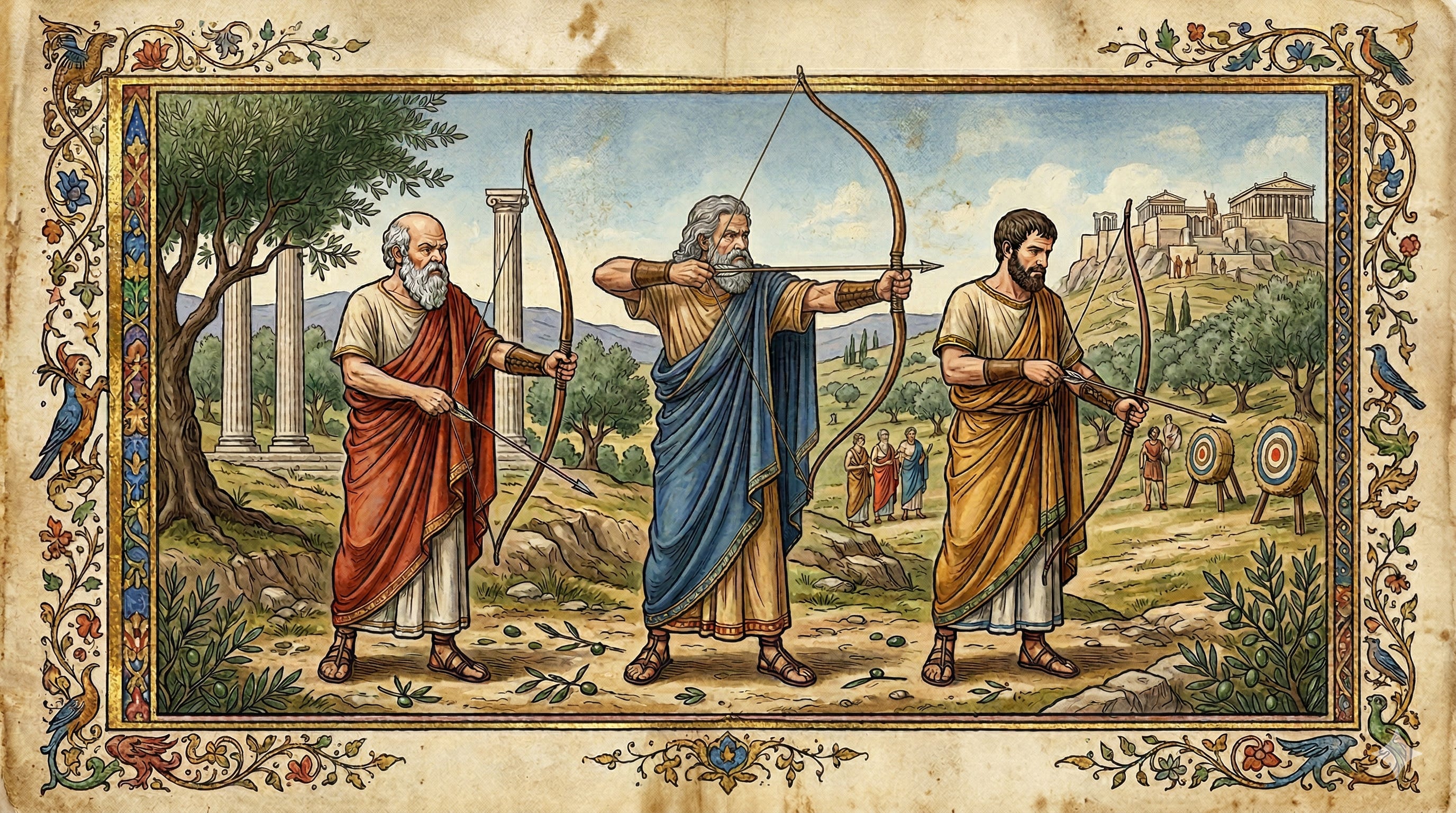
This is where the pendulum often swings too far. Objective truth is like a bullseye on a target. Objective truth gives us a standard of measurement that is independent of our subjective application. The closer we align with truth, the better our lives become. A beginning archer can find hitting the bullseye difficult, but with training, they may be able to get close, or even hit it. Scoring more points, ie, living a better life. If we deny the existence of absolute truth, we don’t remove the bullseye. We give ourselves permission to move the bullseye to wherever our arrow happened to go. Even if we didn’t hit the target at all. In an archery competition, this could be frustrating, but is also not that consequential to life. However, imagine an archer in an ancient battle who had been trained to think that anywhere their arrow went would be the bullseye. They would be incompetent and at worst, useless to helping us to win the battle. Learning to hit the target isn’t about getting better at practice, its about instinctively developing the ability to hit the target when it matters.
Learning how to align our lives with objective truth matters because life is not a simple archery competition. The choices we make (arrows we shoot) have consequences. Good consequences are a result of actions aimed properly at truth. Bad consequences are a result of actions aimed improperly. If this framework did not exist, neither could the concepts of good and bad.
application is the problem
Another word we can use for the “application of truth to our lives” is tradition.
One of our key issues related to everything - not just prosperity - is not truth. It is the traditions - applications and interpretations - we have attached to truth. Many people have elevated their application of truth to the level of truth itself. In other words, like the problem Jesus described in Mark 7, we have elevated man-made ideas (interpretations) to the level of the commands of God. What do your traditions say about prosperity? In the context of your life, what do your traditions say about truth? Traditions, interpretations and applications are both unavoidable and subjective. When these things are not in alignment with truth, we have a decision to make. Will we cling to tradition like Pharisees? Or will we sacrifice the safety of our traditions on the altar of truth? This is why Paul said “the greatest of these is love” and Meldenius said “in all things charity.” No human being sees truth clearly, or applies it accurately. The human mind is not the Divine mind.
We don’t seem to have the ability to be precise in both our understanding and application of truth. One day, we will see things as God sees. We will transcend human thinking and imperfection. We will leave the world of shadows and enter the world of forms. Until that day, our understanding of truth will always be limited by our human mind. That does not mean it is not worth the pursuit. If wisdom is the ability to make finer distinctions, we must be able to draw a distinction between sophia and phronesis, Scripture and interpretation, truth and tradition. People who are unable to see this distinction think that traditions are truth. In order to understand what God wants to teach us about life, prosperity and everything else, we need to make sure that truth is given its rightful place above traditions. Not the other way around.
“Truth is so obscure in these times, and falsehood so established, that, unless we love the truth, we cannot know it.” / Blaise Pascal